
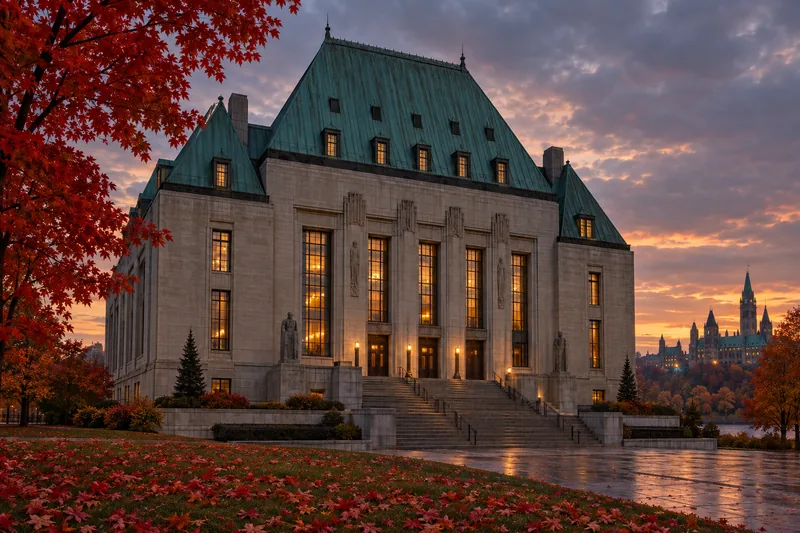
The Supreme Court of Canada heard Ontario’s cross-border online gaming case on Wednesday, October 7, and several justices made clear they had doubts about the province’s central argument. At issue is whether Ontario can let players on its regulated poker and casino sites compete against people in other countries. After several hours of argument, Chief Justice Richard Wagner said the court would take the case under advisement, according to reporting by Covers. No date has been set for a ruling.
For Ontario’s online poker players, the stakes are concrete. Every AGCO-registered poker room in the province, including GGPoker Ontario and PokerStars on FanDuel, runs a closed player pool limited to people physically located in Ontario. A ruling for the province would open the legal path to sharing tables with players abroad. A ruling against it would keep the closed pool in place.
Three Words at the Centre
The case, Atlantic Lottery Corporation, et al. v. Attorney General of Ontario (docket 42141), turns on a short phrase in the Criminal Code. Section 207(1)(a) allows a provincial government “to conduct and manage a lottery scheme in that province.” Gambling is otherwise a criminal offence in Canada. The question referred to the courts is whether online gaming and betting in Ontario would remain lawful if its users were allowed to play with people outside Canada.
Ontario’s answer is that it would conduct and manage only the Ontario side of each game. Players abroad would play through their own local sites under their own regulators, with the arrangement set out in contracts and agreements, much as some European countries pool online poker players today.
“At the end of the day, you are only participating in a scheme conducted by Ontario in Ontario,” said Joshua Hunter, counsel for the Attorney General of Ontario, as reported by Covers. His colleague Ananthan Sinnadurai put it more directly, according to Courthouse News Service: “We choose who we partner with. We still run the system in this province, and fundamentally we control the experience of people in Ontario.”
Sceptical Questions From the Bench
Justice Malcolm Rowe was the sharpest critic of that framing. “You’re saying, in effect, you’re controlling it through contractual means, but that doesn’t mean manage and conduct within the meaning of the act,” he told Ontario’s lawyers. “I mean, it’s playing with words.” He also described Ontario’s position as a “word salad,” Covers reported.
Justice Mahmud Jamal appeared receptive to the lotteries’ criticism of the lower court. Matthew Milne-Smith, counsel for the Atlantic Lottery Corporation, argued that the Court of Appeal for Ontario had relied on the absence of an express ban on international play. “This is backwards,” he said. Because gambling is illegal in Canada, “everything that is not expressly permitted is prohibited.” Justice Jamal replied: “It looks like it was done back-to-front when you read the majority’s reasons,” according to Courthouse News.
Justice Jamal also noted who was missing. “I’m struck by the fact that this is a criminal provision, and the Attorney General of Canada isn’t here to say this is contrary to our public policy,” he said. Chanakya Sethi, also for the lotteries, responded that the dispute is between two sets of provinces, so it was “not surprising that the federal government might be neutral.”
Who argued
- Appellants: Atlantic Lottery Corporation, British Columbia Lottery Corporation, Manitoba Liquor and Lotteries and Loto-Québec, represented by Matthew Milne-Smith and Chanakya Sethi.
- Respondent: Attorney General of Ontario, represented by Joshua Hunter and Ananthan Sinnadurai.
- Interveners presenting oral argument, per the court’s docket: the Attorney General of Alberta, Flutter Entertainment (parent of PokerStars and FanDuel), NSUS Group (parent of GGPoker) and the Canadian Gaming Association.
What the Lotteries Want
The four government-owned lottery corporations argue that Ontario’s model would let the province launch online gaming in partnership with international operators, many of which they say operate illegally in the rest of Canada. They also allege that some private operators use their Ontario licences as “springboards” to steer Canadians in other provinces toward offshore sites.
“This court should not approve a dramatic expansion of online gaming to encompass foreign gamblers based on handwaving about how it’s going to happen in practice,” Mr. Milne-Smith said near the end of the hearing.
Mr. Sinnadurai told the court that iGaming Ontario has directed the sites it oversees to stop redirecting other Canadians to international sites, but said those concerns had “nothing to do with the proposed model we’ve set forward.” Justice Rowe suggested that the commercial dispute was beside the point. “I’m here to figure out what this statute says is legally permissible,” he said. “Your client may be encroaching on what your friend’s client thinks is his territory. That’s not our business.”
How the Case Got Here
Ontario referred the question to its Court of Appeal in 2024. Last November, four of the five judges on that panel found the international model lawful. Justice Katherine van Rensburg dissented, finding that parts of the scheme would not be conducted and managed by Ontario. Several of the questions from the Supreme Court bench on Wednesday tracked her reasoning, according to Courthouse News. The lottery corporations appealed as of right, and the hearing was set in July. Our earlier report and the shared liquidity timeline set out the full history.
Why It Matters for Ontario Poker
The poker numbers explain why operators care. In August, Ontario’s peer-to-peer poker market took CA$122 million in cash wagers, down 19 per cent from a year earlier and about 1.3 per cent of the province’s total handle, as our analysis of iGaming Ontario data showed. The gap with the global market is wide. The international WSOP Online Main Event in September drew 6,008 entries and a US$28.5-million prize pool. Ontario players could not enter it, as we reported at the time. A week later, a bracelet event in the Ontario-only series drew 535 entries.
Covers noted that a ruling for Ontario could also open the door to provincially regulated daily fantasy contests, which are not offered in the Ontario market today. A ruling against Ontario could push the province toward other options, such as pooling with other provinces. Alberta, which launched its own regulated market in July, argued in support of Ontario.
What Happens Next
The Supreme Court typically takes several months to rule on reserved appeals, and it has given no indication of timing in this case. Until it rules, nothing changes for players. Ontario’s regulated poker rooms remain open only to people aged 19 or over who are physically located in the province, and every table remains Ontario-only. OntarioPoker.com will report the decision when it is released.
Reporting draws on hearing coverage by Covers (Geoff Zochodne) and Courthouse News Service (Tatiana Mulowayi-Pelletier), both published October 7, 2026, the Supreme Court of Canada docket for file 42141, and prior OntarioPoker.com coverage. Quotations from the hearing are as reported by those outlets. The illustration is AI-generated for editorial purposes. Online poker in Ontario is limited to players aged 19 or over who are physically located in the province. Free, confidential help is available 24 hours a day from ConnexOntario at 1-866-531-2600.