
By Alex Drummond, Editor-in-Chief · August 26, 2026 · Fact-checked by Maya Chen
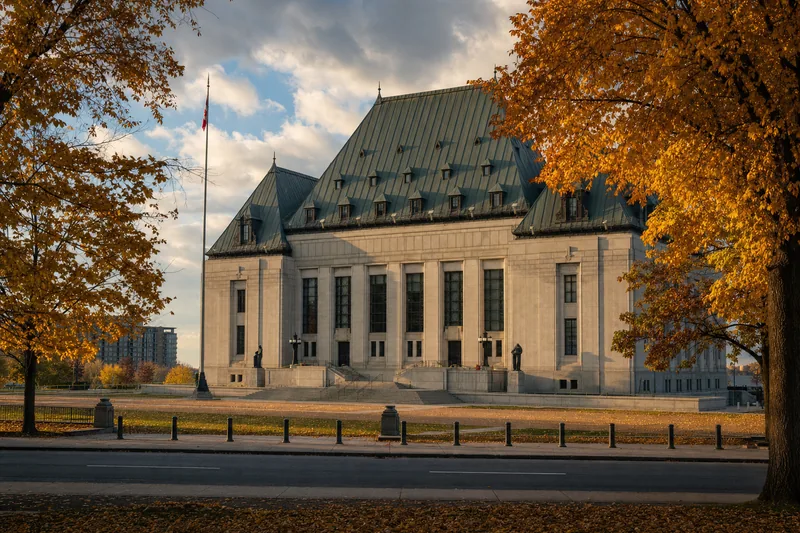
TORONTO - The Supreme Court of Canada has set October 7, 2026 as the hearing date for Atlantic Lottery Corporation, et al. v. Attorney General of Ontario, the as-of-right civil appeal that will decide whether Ontario's regulated online poker and daily fantasy sports markets can lawfully connect Ontario-based players to peer-to-peer pools in other jurisdictions. It is, by a considerable margin, the single most consequential piece of Canadian iGaming litigation since the Ontario market opened in April 2022, and it lands six weeks from now on the docket of a nine-judge bench in Ottawa. Ontario's approximately 1.3 million active regulated online-gaming accounts are the largest constituency affected by the outcome.
The hearing date was confirmed in the Court's case database in mid-July 2026 and has not shifted since. It comes after nearly two years of layered lower-court proceedings, a landmark Ontario Court of Appeal ruling that split 4-1 in Ontario's favour in November 2025, and a formal appeal filed by the government-owned Canadian Lottery Coalition (CLC) in December 2025.
The commercial signal from Canadian operators is unambiguous. GG International Limited, the parent of GGPoker and GGPoker Ontario, secured Alberta's first-ever online poker registration on August 12, 2026, making the operator the first regulated peer-to-peer poker site licensed to accept Albertans since the province's Play Alberta open-market launch on July 13. As of this report, GGPoker has not launched in Alberta and has offered no launch date. Whether it launches at all before the SCC ruling is now widely expected to hinge on the October decision, or on how quickly the Court hands down reasons after arguments.
What the Court Will Decide
The reference question before the Supreme Court, inherited verbatim from the Ontario Court of Appeal proceeding, reads as follows: "Would legal online gaming and sports betting remain lawful under the Criminal Code if its users were permitted to participate in games and betting involving individuals outside of Canada as described in the attached Schedule? If not, to what extent?"
The Schedule referenced in the question is annexed to Ontario Order-in-Council 210/2024. It describes the province's proposed pooled-liquidity model in operational terms: Ontario players would continue to access games through iGO-registered websites and applications, while foreign players would access the same peer-to-peer game via websites and applications regulated in their own jurisdictions. iGaming Ontario would retain conduct-and-management authority over the Ontario end of the game. No player located in a Canadian province other than Ontario would be permitted to participate unless Ontario had entered into a formal interprovincial agreement with that province's regulator.
That last carve-out is the mechanism through which any future Ontario-Alberta shared-liquidity arrangement would need to be negotiated. It is also the reason Alberta's Attorney General Mickey Amery filed a motion to intervene at the Supreme Court in March 2026: whatever the Court decides in October will directly determine whether Alberta's newly regulated iGaming market can be linked to Ontario's, and on what terms.
The Ontario Court of Appeal Ruling: A 4-1 Majority
The proceeding at the Court of Appeal for Ontario was heard over three days in November 2024 by a five-judge panel comprising Tulloch C.J.O., Gillese, van Rensburg, Hourigan and Dawe JJ.A. Decision was reserved for nearly a year. On November 12, 2025, the Court released Reference re iGaming Ontario, 2025 ONCA 770, answering the first reference question in the affirmative by a 4-1 majority.
The majority concluded that the proposed pooled-liquidity model is lawful under section 207(1)(a) of the Criminal Code, provided three conditions are met: Ontario continues to conduct and manage its own iGO-registered sites through its agents; players in other Canadian provinces are not permitted to participate absent an interprovincial agreement; and Ontario maintains "the necessary level of control and regulation over the Ontario-based aspects of the scheme".
The majority also expressly rejected the position, advanced by the Attorney General of Ontario in a fallback argument, that section 207(1)(a) should be read to require only a "real and substantial connection" to the province. The Court concluded that the plain-language requirement to "conduct and manage" a lottery scheme "in that province" is capable of encompassing a scheme that links Ontario-based play to play in foreign jurisdictions, so long as the Ontario end remains under provincial conduct and management. Van Rensburg J.A., in dissent, would have answered the reference question in the negative on the ground that the international-liquidity feature is the "raison d'etre" of the proposed model and, on the dissent's reading of the statute, falls outside the exemption in section 207(1)(a).
Why the Canadian Lottery Coalition Appealed
The Canadian Lottery Coalition intervened at the Court of Appeal for Ontario as the effective opposition to Ontario's position. It filed a notice of appeal to the Supreme Court of Canada within the 30-day window that opened on November 12, 2025. Atlantic Lottery Corporation filed the initial notice on December 10, 2025. The case was opened at the Supreme Court on December 18. The Coalition filed its factum on February 13, 2026.
The Coalition's four members currently active in the appeal are Atlantic Lottery Corporation, British Columbia Lottery Corporation, Manitoba Liquor and Lotteries, and Lotteries and Gaming Saskatchewan. Their core argument, restated in the February factum, is that section 207(1)(a) of the Criminal Code should be read to require gaming to be actually conducted and managed within the boundaries of the province in question, not merely "from" or "partially in" that province. On the Coalition's reading, a game that permits real-time betting between players in Ontario and players outside Canada is a single game conducted and managed across multiple jurisdictions, which section 207(1)(a) does not authorise.
The Coalition further argues that the Ontario Court of Appeal misapplied or sidestepped the Supreme Court's 2020 decision in Atlantic Lottery Corp. Inc. v. Babstock. The lottery corporations also invoke a broader public-policy argument, citing an estimated CA$1.86 billion in profits that they say unlawful offshore operators diverted from provincial governments and public services in 2023. That figure has been contested by the Ontario side of the docket but appears repeatedly in Coalition filings.
The Attorney General of Ontario is the respondent and, on the Coalition's own submissions and multiple secondary reports, is expected to lead in defending the November 2025 ruling. Intervener status at the Supreme Court has also been sought by the Canadian Gaming Association, Flutter Entertainment plc (owner of PokerStars and FanDuel), and NSUS Group Inc. (parent of GGPoker), all of which held intervener status at the Court of Appeal for Ontario.
Alberta as the Immediate Test Case
The Play Alberta market opened on July 13, 2026, and by the closing week of August had 28 licensed iGaming sites operating in the province, in addition to Alberta Gaming, Liquor and Cannabis's own government-owned platform. Among the licensed operators, only GGPoker holds a peer-to-peer online poker registration, and, as noted, GGPoker has not yet launched. Alberta players cannot legally access regulated online poker as of the date of this article.
The commercial reason for that delay has become an open industry secret over the past 60 days. Alberta's population is approximately 5.1 million, of whom roughly 3.9 million are of legal gambling age. On a stand-alone ring-fenced basis, that produces a peer-to-peer poker liquidity pool materially smaller than Ontario's approximately 16 million (12.7 million of legal age) and dramatically smaller than the international dot-com pools that GGPoker operates outside Canada. In the ring-fenced Ontario market, peer-to-peer poker has consistently produced only 1 to 2 per cent of monthly total iGaming operator revenue since April 2022, and the current run-rate of approximately CA$5.2 million per month places the province's regulated poker vertical materially below the volumes at which the biggest guaranteed-prize-pool tournaments become economical to seed.
Combining Ontario and Alberta pools under a formal interprovincial agreement would raise the underlying player-base ceiling to roughly 21 million people, or approximately 16.6 million of legal age. That is comparable in scale to the population of Australia or the state of New York, and it is large enough to support materially bigger guaranteed prize pools and materially more sustainable tournament schedules. It is also small compared with the population base that Ontario would gain by connecting into an international pool with regulated European or US-state markets, which is the direction the November 2025 ONCA ruling explicitly permits.
Timeline: From ONCA Reference to SCC Hearing
- April 2024: Order-in-Council 210/2024 issued; Attorney General of Ontario refers reference question to the Court of Appeal for Ontario.
- November 26-28, 2024: Court of Appeal for Ontario hearings, three days, panel of five.
- November 12, 2025: Court of Appeal releases Reference re iGaming Ontario, 2025 ONCA 770. Majority (4-1) rules Ontario's proposed model lawful under section 207(1)(a) of the Criminal Code.
- December 10, 2025: Atlantic Lottery Corporation files notice of appeal to the Supreme Court of Canada.
- December 18, 2025: SCC opens the case, docket Atlantic Lottery Corporation, et al. v. Attorney General of Ontario.
- February 13, 2026: Canadian Lottery Coalition files factum with the SCC.
- March 24, 2026: Alberta AG Mickey Amery files motion to intervene at the SCC.
- July 13, 2026: Alberta launches regulated iGaming market (no poker yet).
- Mid-July 2026: SCC case database confirms October 7, 2026 hearing date.
- August 12, 2026: GGPoker becomes first online poker operator registered in Alberta; no launch date set.
- October 7, 2026: Supreme Court of Canada hearing.
- Expected 2027: SCC written reasons, timing uncertain. Complex constitutional references typically produce reasons six to eighteen months after hearing.
What a Ruling in Ontario's Favour Would Mean for Ontario Poker Players
Under the framework established by the November 2025 ONCA ruling, and assuming the Supreme Court upholds it in some form, Ontario would still need to complete a substantial regulatory implementation before Ontario players can be seated at the same virtual tables as players outside the province. The Court of Appeal expressly declined to specify operational terms, timelines, or obligations, and iGO has not, as of the date of this article, published a draft international-liquidity framework. On the timelines observed in comparable European regulatory rollouts, the practical earliest realistic date at which Ontario players could be pooled with international counterparts on regulated peer-to-peer poker is late 2027, and more probably 2028.
The intermediate step, an Ontario-Alberta interprovincial agreement, is capable of moving faster because it does not require reciprocal international regulatory cooperation. If both provinces prioritise it, an inter-provincial memorandum of understanding is plausible in 2027 and a live cross-border poker product in the same year. GGPoker Ontario and (if GGPoker launches in Alberta) GGPoker Alberta would be the natural first operator to run a combined pool, since both markets would be served by the same NSUS-owned technology stack and Playtech's iPoker software layer. PokerStars-on-FanDuel, which currently operates the Ontario segment on Playtech iPoker following the May 2026 platform migration, would be a second candidate but would need its own Alberta AGLC registration first, and no such registration has been announced.
For Ontario players, three effects on the current market would follow. First, guaranteed prize pools on marquee tournaments would rise materially. The current headline guarantee on GGPoker Ontario's largest ring-fenced Sunday tournament is in the six figures. A combined Ontario-Alberta pool would support seven-figure Sundays with plausible field sizes; a Ontario-plus-Europe pool would support eight-figure Sundays. Second, cash-game seat availability at higher stakes, currently the single most-cited weakness in the ring-fenced Ontario market, would improve on both sides. Third, and most consequentially for provincial revenue lines, iGO's monthly peer-to-peer poker NAGGR line would rise from its current run-rate. Poker's current 1 per cent share of Ontario iGaming revenue is a floor, not a ceiling. Analysts covering Flutter and Entain have modelled a doubling to tripling of Ontario poker revenue within eighteen months of any international linkage, though those projections carry substantial uncertainty and depend on which foreign markets Ontario ultimately partners with.
What a Ruling Against Ontario Would Mean
If the Supreme Court accepts the Canadian Lottery Coalition's core argument, Ontario's proposed pooled-liquidity model would be constrained to whatever narrower structure the Court's reasons permit. The most likely narrow outcome is that peer-to-peer play with players outside Canada would remain unlawful, while the November 2025 ONCA ruling's implicit permission for interprovincial cross-border play (via inter-provincial agreements) survives. That would leave Alberta as Ontario's only practical partner for the foreseeable future and place a hard ceiling of roughly 21 million people on the total Canadian regulated pool available to Ontario players. It would also, by removing the international upside, materially reduce the commercial urgency for operators to invest in shared-liquidity infrastructure at all.
An outright loss for Ontario, in which the Court holds that the proposed model contravenes section 207(1)(a) even in its interprovincial form, would leave Ontario's ring-fenced market frozen at its current structure indefinitely. That is the scenario Ontario players should be most alert to in early October, and it is the reason the CLC filed the appeal in the first place: any Court of Appeal ruling in Ontario's favour has, on the Coalition's reading, downstream consequences for how other provinces regulate their own iGaming markets.
Immediate Effect on the Ontario Regulated Market: None
For Ontario's roughly 46 registered iGaming operators, and the six regulated online poker rooms currently serving Ontario players (GGPoker, PokerStars on FanDuel, BetMGM Poker, 888poker, PartyPoker, and Bwin), the immediate effect of the SCC hearing is nil. All six rooms will continue to operate ring-fenced Ontario-only player pools until and unless iGO promulgates a regulatory framework implementing shared liquidity. That framework does not exist and, per iGO's own public statements, will not be drafted until after the Supreme Court has ruled.
The medium-term commercial pressures on the market are, however, real. Ontario peer-to-peer poker revenue in June 2026 hit an 18-month low of CA$5.2 million, its lowest reading since December 2024. Operators, particularly those with parent-company presence in the global dot-com market, have privately signalled to industry counterparts that a ruling against Ontario would materially reduce their willingness to invest in ring-fenced Ontario product roadmaps beyond current commitments. Whether or not that signal converts into public statements from Flutter or NSUS in the six weeks between now and the hearing is worth watching.
Related Coverage
- Original March 2026 SCC appeal filing and coalition membership
- Alberta iGaming market launch (July 13, 2026)
- Alberta four days in: no regulated poker
- Shared liquidity explainer
- Canada shared-liquidity timeline
- Is online poker legal in Ontario?
Sources
- Sports Shield, "Supreme Court Sets Oct. 7 Hearing in Ontario Pooled Liquidity Appeal", July 15, 2026.
- Card Player, "Alberta Grants First Online Poker License to GGPoker", August 23, 2026.
- Casino.org, "GGPoker Gets Alberta Licence as Poker Market Grows", August 17, 2026.
- Pokerfuse, "Appeal Challenges Ontario Ruling on International Online Poker", December 26, 2025.
- Covers.com, "Canada's Supreme Court Asked to Nix Ontario DFS, Poker Plans", February 23, 2026.
- Pokerfuse, "Alberta Enters Supreme Court Discussions on Ontario Player Pooling", March 24, 2026.
- BLG, "A big win for Ontario: Court of Appeal decision allows international pooled liquidity in online gaming", November 17, 2025.
- Osler, "Another step forward for Internet gaming in Ontario", November 21, 2025.
- Cassels, "Ontario's Proposed iGaming Model Affirmed", November 17, 2025.
- Court of Appeal for Ontario, Reference re iGaming Ontario, 2025 ONCA 770, released November 12, 2025.
- iGaming Ontario, monthly market performance reports, April 2022 to June 2026.