
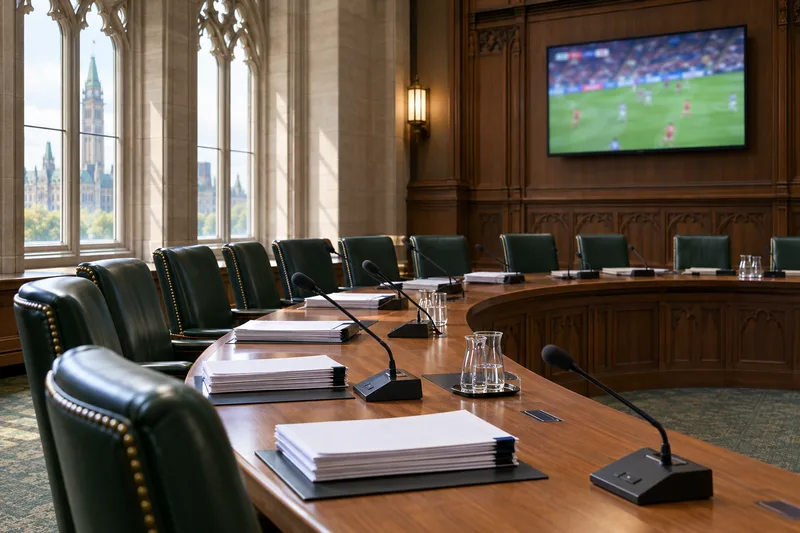
A Senate bill that would require Ottawa to draw up a national framework on sports betting advertising cleared the House of Commons Standing Committee on Canadian Heritage on Tuesday, November 3, in a weaker form than the one that arrived. Liberal amendments doubled the deadline for the framework’s report and made consultation with other ministers optional, InGame reported. Bill S-211 now returns to the full House for third reading. Because the committee changed the text, it will also have to go back to the Senate.
For Ontario’s online poker rooms, the bill’s most important feature is what it leaves out. S-211 deals only with sports betting advertising. It does not reach online casino or poker promotion, Casinos.com noted, even though several witnesses urged the committee to widen it.
What the Committee Changed
According to InGame, the committee adopted only Liberal amendments and rejected every change Conservative members proposed. The bill advanced “on division,” meaning it passed without a recorded vote. The amended bill:
- gives the government two years, rather than one, to report to Parliament, and 15 days rather than 10 to publish the report after tabling;
- replaces the Minister of Canadian Heritage as the responsible minister with whichever member or members of the King’s Privy Council the government designates;
- changes “national standards” to “clinical guidelines” in the section on preventing and diagnosing harmful gambling;
- says the minister “may” rather than “must” consult, and replaces a list of six named ministers with “anyone the Minister wishes.”
Among the rejected proposals was one from Conservative MP Andrew Lawton that would have required the framework to ban advertising for in-game betting. Liberal MP Fares El Soud said such specifics would reduce the framework’s flexibility. Amy Awad of the Department of Canadian Heritage told members that prescriptive language “may influence the deliberations that would generate a framework,” but that “broad language allows for anything to be put in.” iGaming Times summarized the result as a bill with a longer deadline, looser consultation duties and no in-game advertising ban.
The framework would still have to consider limits on “the number, scope or location” of sports betting ads and on the use of celebrities and athletes. The bill does not itself ban or restrict any advertisement.
Ontario Wants to Keep the File
The bill reached this stage with broad support in the House, which approved it at second reading by 291 votes to 28 on April 22, according to LEGISinfo. The province that hosts Canada’s largest regulated online market is not among its supporters. Attorney General Doug Downey has told the federal government in a letter that Ontario should be left to regulate advertising, RG.org reported, citing CBC. Alberta’s Dale Nally wrote that the bill would create “a two-tier regulatory system.” Bloc Québécois MP Martin Champoux called it “an interference in Quebec and in the province’s jurisdiction.”
Ontario already has its own rules. Since February 28, 2024, AGCO standards have barred registered operators from using active or retired athletes in marketing, except in responsible-gambling messages, and have restricted celebrities and influencers likely to appeal to minors, as we reported in May. A provincial attempt to go further, Bill 107, the Stop Harmful Gambling Advertising Act, was defeated at Queen’s Park on May 13.
The Poker Question
Several submissions to the committee argued that limiting the framework to sports betting misses most of the market. The Canadian Psychological Association called for “an immediate ban on commercial advertising, marketing, and promotion of online gambling, including sports betting, online casinos, slots, poker, and other gambling products” in its brief. The Canadian Centre on Substance Use and Addiction and Greo Evidence Insights asked the committee to “consider measures to address all online gambling advertising and promotion” in a joint submission. None of the amendments reported by InGame widened the bill’s scope.
That leaves poker advertising in Ontario governed by provincial standards alone. In practice the line is blurred. Several of the province’s poker rooms belong to companies that also run Ontario sportsbooks, including BetMGM and PokerStars on FanDuel. Any federal limits on sports betting advertising could shape how those brands market themselves in the province, even if the poker products are not named.
The political mood is also moving faster than the bill. The bill’s Senate sponsor, Ontario senator Marty Deacon, told the committee on October 29 that she would “love a full ban” on sports betting advertising, The Wire Report reported. That debate is unfolding against new evidence of harm in Ontario, including a CBC report estimating roughly 130,000 problem gamblers in the province, as we reported last month, and iGaming Ontario’s shelved prevalence study.
What Comes Next
InGame reported that it is not clear when the House will take up the bill at third reading. The chamber has 23 sitting days scheduled before it rises on December 11. If the House passes the amended text, the Senate must agree to the changes before the bill can receive royal assent. Even then, the government would have two years to produce its report, so no new rule would apply to Ontario operators for some time. Our responsible gambling page lists the tools available to players now.
Reporting draws on InGame (Jill R. Dorson, November 4, 2026), iGaming Times, LEGISinfo, RG.org’s summary of CBC reporting, Casinos.com, The Wire Report, submissions published by the Canadian Psychological Association and the Canadian Centre on Substance Use and Addiction, and prior OntarioPoker.com coverage. The amendments are described as reported by InGame; OntarioPoker.com has not independently reviewed the committee’s amended text. The illustration is AI-generated for editorial purposes. Online poker in Ontario is limited to players aged 19 or over who are physically located in the province. Free, confidential help is available 24 hours a day from ConnexOntario at 1-866-531-2600.