
By Alex Drummond, Editor-in-Chief · June 9, 2026 · Fact-checked by Maya Chen
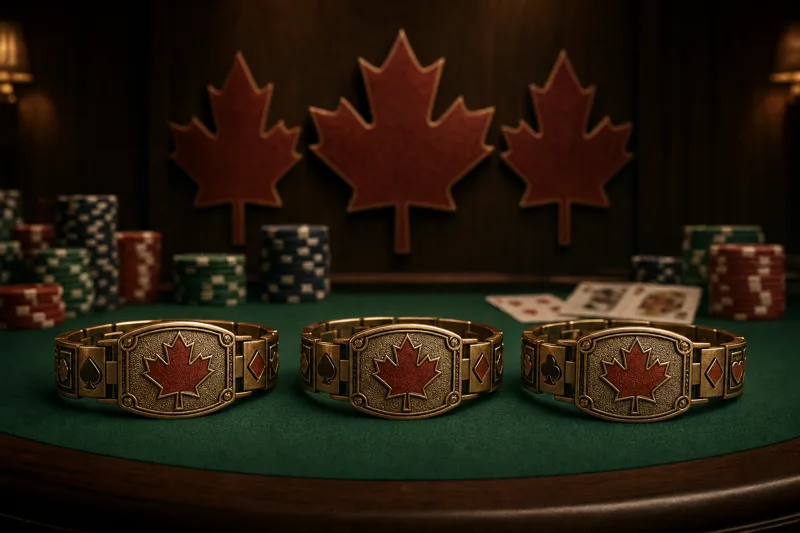
LAS VEGAS - Canadian poker has produced a result on Monday night that, on the published record, has no recorded modern equivalent. Christopher Alcindor, a 30-something Montreal cash-game and online grinder with two prior WSOP Circuit rings out of Calgary and a Hendon Mob live tournament total that had not yet crossed the half-million-dollar mark, defeated American James Roullier in a short heads-up battle at the Horseshoe and Paris in Las Vegas to take down Event #22, the $1,500 Big O. The first-place prize of US$387,110, on Alcindor's pre-tournament career graph, more than doubles his lifetime live tournament earnings in a single tournament. The bracelet itself, the most prestigious piece of hardware in the sport, is the third Canadian gold of the 2026 World Series of Poker in three calendar days. There is no comparable cluster anywhere in the modern series archive.
The Saturday-into-Sunday-into-Monday sequence reads, in chronological order, as follows. On Saturday night, Quebec PLO regular Frederic Normand won Event #21, the $1,500 Pot-Limit Omaha Hi-Lo Eight-or-Better, for US$235,377, ending the twelve-day Canadian bracelet drought to open the 2026 series. On Sunday night, less than twenty-four hours later, Toronto-trained professional Kristen Foxen won Event #19, the $25,000 High Roller No-Limit Hold'em, for US$1,773,083, the largest live tournament prize of her career and her sixth WSOP gold bracelet overall. On Monday night, less than twenty-four hours after that, Alcindor closed the third bracelet of the 72-hour Canadian arc. The combined Canadian gold-event payout across the Normand-Foxen-Alcindor stretch, on the published WSOP results pages, totals US$2,395,570.
The Final Table
Event #22, the $1,500 Big O, played out at the Horseshoe and Paris across two opening flights and a single bracelet-day Day 3. The two flights, by the PokerNews tournament page, drew 2,150 hopefuls and generated a US$2,802,785 prize pool. Twenty-nine players returned for Day 3 on Monday afternoon. The final eight, set by the late-evening dinner break, then played for almost six hours to determine a winner. The six-handed stretch alone ran for nearly three hours. Senovio Ramirez was the first short-stack out, three-bet jamming with rolled aces against Alcindor's ace-king-king-four-three and getting unlucky on a board that delivered both high and low cards but no help for the better pre-flop hand. Anthony Reategui followed in seventh, jammed over a limp with a jack-high holding and ran into Dimitri Melissourgos's ace-king-eight-three-deuce, which made top two pair. Thomas Koral, who had been short for an extended stretch, then bowed out in sixth, getting in with ace-jack-six-five-four only for Alcindor to scoop the pot by rivering a wheel with the three-deuce in his hand.
Song Wang, the only Chinese-flagged player on the final table, busted fifth. Wang had moved all-in with a four-card low draw and an ace-eight-eight pair, but Roullier had flopped trip eights and Wang missed a slim two-outer on the river. The fourth-place exit went to Melissourgos, who got it in with ace-king-jack-four-four against Alcindor's ace-king-ten-four-deuce. Alcindor turned a full house on the four-jack-four board, and the chip dynamics of the table shifted permanently in his direction. Scott Abrams, the three-handed short stack, then ran top pair and a Broadway low wrap into Alcindor's top two pair on a three-way pot that bricked out, and the bracelet was effectively decided. The heads-up confrontation between Alcindor and Roullier ran only a handful of hands. Roullier got it in on a flopped pot with the nut flush draw, ran into Alcindor's trip jacks, and the turn and river did not save him.
| Place | Player | Country | Prize (US$) |
|---|---|---|---|
| 1 | Christopher Alcindor | Canada | $387,110 |
| 2 | James Roullier | United States | $258,690 |
| 3 | Scott Abrams | United States | $187,150 |
| 4 | Dimitri Melissourgos | United States | $136,820 |
| 5 | Song Wang | China | $101,128 |
| 6 | Thomas Koral | United States | $75,600 |
| 7 | Anthony Reategui | United States | $57,150 |
| 8 | Senovio Ramirez | United States | $43,700 |
The international weighting of the final eight (United States 6, Canada 1, China 1) is consistent with the field-internationalisation pattern this newsroom has been tracking across the 2026 series in the smaller-buy-in mixed-game events, where the typical pattern remains a mostly American field with a thin layer of high-volume international specialists.
The Winner's Profile
Alcindor, by the published live tournament archive, is a relative newcomer at the open-event WSOP level. The PokerNews wrap, posted shortly after the trophy ceremony, recorded that he had been "playing poker for years" but primarily online and that he had been increasing his live tournament volume "over the past two years." His career live tournament earnings, before the Monday-night cash, sat at "nearly $400,000." The first-place prize at Event #22 alone added US$387,110, which roughly doubles that lifetime number in a single tournament. His prior WSOP-branded results are the two WSOP Circuit gold rings he won at Calgary's Deerfoot Inn and Casino, in May 2024 and January 2025, a stretch that this newsroom covered in its 2026 WSOP Circuit Toronto preview as part of the broader Calgary-to-Toronto Canadian Circuit pipeline. His only prior cash at the 2026 main WSOP, by the published live-coverage feed, was a 72nd-place finish in Event #6, the $1,500 Pot-Limit Omaha Eight-or-Better, for US$3,525.
The split-pot Omaha specialisation is the through-line. The Hi-Lo format, on Alcindor's own account in the post-victory PokerNews interview, is his favourite. "I finished 499th in the Main Event last year, but Hi-Lo is really my favourite," Alcindor told the desk. "People were asking me if I was going to play the Monster Stack or something else. And I was like, 'No, I came here to play Hi-Lo.'" His online background, by his own framing, was the 80-hour-per-week kind. "I used to play online for 80 hours a week, and that can take a toll on you," he told PokerNews after the win. "But if you prioritise quality over quantity, then you have more energy, and you're able to give your best." The Hi-Lo formats, by Alcindor's own admission, are also the ones that swing the hardest. The final table, in his telling, was "long," with "like a dozen all-ins" across the late stages, and a personal strategic adjustment to lean off ICM-pressure raises when several short stacks at the table were content to call off light.
The Three-in-Three Pace
The 72-hour Canadian bracelet cluster has, on the modern record, no clear equivalent. The Foxen-Normand back-to-back, completed on Sunday night, had already produced the fastest two-in-two Canadian conversion in the modern WSOP archive, breaking a prior approximate 72-hour two-in-two from the 2024 series. The addition of the Alcindor bracelet on Monday night turns the two-in-two into a three-in-three, which the published WSOP results archive does not record for any prior Canadian cluster across the modern era. The 2024 Canadian summer, the prior point of comparison, recorded its third Canadian bracelet on what was approximately Day 22 of the series, two weeks later than the 2026 series has now reached at the same count.
The combined Canadian payout, US$2,395,570 across the three gold events, also sits above the prior published Canadian seventy-two-hour record. The Daniel Negreanu and Cyndy Violette back-to-back-and-near-third cluster from the 2024 series, the previous closest modern comparison, totalled approximately US$1.45 million across the same three-event window. The Normand-Foxen-Alcindor cluster, on the dollar count, is the largest single seventy-two-hour Canadian payout at any modern WSOP main series, and the only one to clear the US$2-million bar.
| Bracelet | Day | Player | Event | Prize (US$) |
|---|---|---|---|---|
| 1 | Sat Jun 6 | Frederic Normand | #21 $1,500 PLO Hi-Lo | $235,377 |
| 2 | Sun Jun 7 | Kristen Foxen | #19 $25,000 High Roller NLH | $1,773,083 |
| 3 | Mon Jun 8 | Christopher Alcindor | #22 $1,500 Big O | $387,110 |
| 72-hour total | $2,395,570 | |||
The Historical Context
Alcindor's gold, on the running 2026 series count, takes the Canadian total to three bracelets through Day 14. The two-bracelet pace through Day 13 of the 2024 series, on the prior point of comparison, was the last summer to match the 2026 opening. The 2025 series, by contrast, had recorded only one Canadian bracelet through the same Day 14 marker. The three-bracelet pace, projected forward at a roughly proportionate rate, would put the 2026 Canadian count at a 12-to-14-bracelet total by the close of the series on July 15, comfortably above the prior decade's median Canadian total of seven. The Day 14 pace, however, has historically been a weak predictor of full-summer Canadian counts. The 2024 series, after its strong Day 13 opening, recorded only one further Canadian bracelet across the remaining six weeks of the schedule, finishing on a Canadian gold total of three.
The split-pot specialisation of the Normand-Alcindor pair is also a notable through-line. Both bracelets won by Quebec-based Canadians across the 72-hour cluster were Omaha Hi-Lo derivatives. Pot-Limit Omaha Hi-Lo Eight-or-Better and Big O are technically distinct formats. Big O, the five-card variant in which players are dealt five hole cards rather than four and which has spread aggressively across the North American live cash circuit since the early 2020s, is a specialist game and one that traditionally has rewarded high-volume online grinders who can build the muscle memory across thousands of hands. The Hendon Mob and live tournament archive do not record a prior Big O bracelet for any Canadian player. Alcindor's Monday-night gold is the first.
The Ontario Read
None of the three Canadians on the 72-hour bracelet cluster is, by published residence, a current Ontario resident. Normand is Quebec, Foxen is Toronto-trained but resident in Las Vegas, and Alcindor lists Montreal on his MainEventTravel WSOPC Calgary profile. The Ontario read on the three-in-three is, instead, the read on the regulated provincial market that feeds players into the live tournament pipeline. Ontario, on the latest published iGaming Ontario quarterly numbers, accounts for more than fifty percent of the regulated Canadian online poker handle each quarter, and the largest provincial slice of the AGCO-registered poker player count nationally. The pathway from a regulated provincial online room into a WSOP gold bracelet, by the structural picture, runs through the satellite ladders that the licensed operators choose to run.
The current four-operator regulated provincial market, as of the June 3 launch of PokerStars on FanDuel in Ontario, runs as follows. GGPoker Ontario remains the only AGCO-registered room running official WSOP and WSOPC satellites for players physically located in the province. GGPoker's Ontario-only satellite path to the WSOP Super Circuit Canada at Playground in Kahnawake from August 24 through September 9, announced on Sunday night, is the next significant Ontario-relevant qualifier window and the most direct provincial route into a live North American WSOP-branded event for the rest of the 2026 calendar. PokerStars on FanDuel has not announced any WSOP satellite path. BetMGM Poker and 888poker run their own internal MTT series but not WSOP-branded qualifiers in the Ontario ring-fenced player pool.
The May iGaming Ontario monthly market performance report, due to be published in late June, will be the first regulated-market data set to capture both the FanDuel launch and the first full weekend of head-to-head Sunday play. Whether the regulated Ontario operator landscape continues to channel a rising share of provincial recreational players into the live tournament pipeline, on the multi-year trajectory this newsroom has been tracking, is the structural question that the next several quarterly reports will answer. The Normand-Foxen-Alcindor cluster, on the present trajectory, is a useful proof of concept that Canadian poker on the live tournament floor is operating at or near a record-pace level. The 2026 WSOP Main Event begins July 2.