
By Alex Drummond, Editor-in-Chief · May 26, 2026 · Fact-checked by Maya Chen
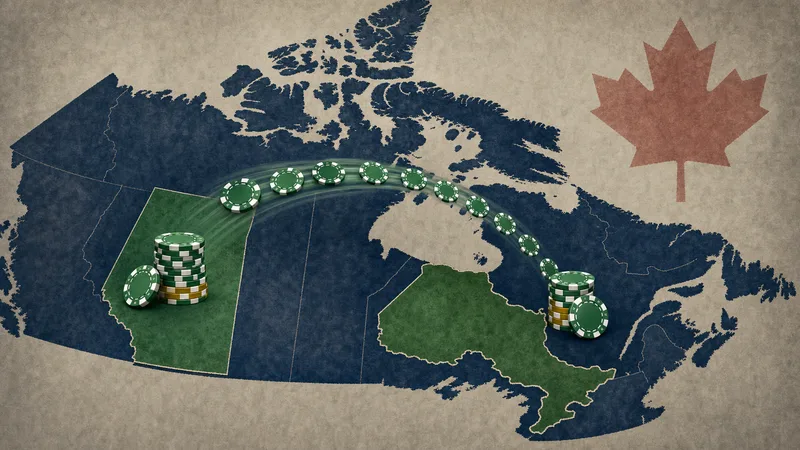
TORONTO - The Alberta iGaming Corporation is actively working on a memorandum of understanding with Ontario that would allow regulated online operators in the two provinces to share player pools, the agency's newly permanent chief executive Dan Keene confirmed on Tuesday in remarks at SBC Summit Canada in Toronto. The disclosure represents the first time a senior Canadian regulator has publicly described interprovincial poker liquidity as a live negotiating file rather than a long-term ambition, and it sets up the most significant structural change to Ontario's ring-fenced regulated market since the province went live in April 2022.
"We are in favor of that," Keene said, according to coverage by Casino.org. "We'll try and get done as quickly as possible with our friends in Ontario." He did not commit to a target date for completion of the MOU, which would be a formal bilateral instrument signed between AiGC and the Alcohol and Gaming Commission of Ontario together with iGaming Ontario, the province's stand-alone Crown agency that contracts with private operators.
The remarks landed roughly seven weeks before Alberta's regulated iGaming market is scheduled to go live on July 13. Keene noted, in a separate line that drew attention from operator delegates in the room, that "poker is especially dependent on liquidity," an explicit acknowledgement that peer-to-peer games are the product category most disadvantaged by the existing provincial ring-fences.
Why This Matters for Ontario Poker
The structural problem for Ontario poker is well documented in this newsroom. When the province's regulated iGaming market launched in April 2022, the AGCO required operators serving Ontario customers to migrate those players into ring-fenced, Ontario-only environments. PokerStars and BetMGM made that move, and the post-migration shrinkage in cash-game traffic and tournament guarantees has been the single most-cited complaint from Ontario players ever since. The cap on field sizes inside the province is mathematical rather than promotional: only people physically located in Ontario can be dealt in, and the province's population gives an upper bound on the rake-active player pool that no operator can engineer its way around.
Alberta's market opens that ceiling, but only modestly on its own. The province has roughly 4.8 million residents to Ontario's 16 million. The combined Alberta-Ontario pool would still be smaller than New Jersey-Michigan-Pennsylvania-Nevada under the United States Multi-State Internet Gaming Agreement, and substantially smaller than the European Union shared pool covering France, Spain and Portugal. But it is the first politically realistic enlargement of an Ontario player pool since 2022, and it directly addresses the format that needs the help most.
"Poker is especially dependent on liquidity," Keene told the room. "The opening up of the player pool for operators in both provinces to access means bigger tournaments, larger player pools, and a healthier ecosystem, and that means a stronger regulated market to compete with international grey market sites."
What the MOU Would Cover
Keene did not enumerate the specifics of the draft instrument, and at this stage the MOU has not been published. Industry counsel briefed on the discussions describe it as a bilateral agreement that, at minimum, would have to address shared technical standards for player verification, allocation of regulatory authority over cross-border events, anti-money laundering reporting, customer-funds segregation, and dispute resolution between operators. The MSIGA in the United States runs to nine pages and is the closest comparable instrument; the Canadian draft is widely expected to be more substantial because the provinces themselves, rather than a quasi-federal body, are the contracting parties.
The political clearing required is also lighter than is sometimes reported. Neither province needs to amend its Criminal Code-derived enabling legislation; both provincial frameworks already contemplate intergovernmental cooperation on gaming. What is required is sign-off from the Attorney General and Solicitor General in each province, alongside the regulators themselves. Ontario's AGCO has not made a public comment on the file as of Tuesday afternoon, and a spokesperson for the Ministry of the Attorney General did not return a request for comment in time for publication.
The Court Case That Could Eclipse It
Running in parallel is the larger constitutional file that could render any Alberta-Ontario MOU a stepping stone rather than an end-state. In November 2025, the Ontario Court of Appeal ruled in a 4-1 decision that Ontario's regulated iGaming market may legally participate in international pooled liquidity, an opinion that would, on its face, open the door for Ontario residents to compete in peer-to-peer games against players outside Canada. The decision has been challenged by several provincial lottery corporations, who argue it would undermine the geographic limits traditionally attached to provincially managed gaming schemes, and the file is now before the Supreme Court of Canada.
Alberta is an intervenor in that case. Keene, asked at the conference where his province sits, was unambiguous. "I think you'll find our position is one which we're supportive of international liquidity," he said. "From a business and commercial perspective, it makes a lot of sense."
Practically, that means the Alberta-Ontario MOU is being negotiated in the shadow of a Supreme Court decision that could overtake it. If the court upholds the Court of Appeal opinion in full, Ontario operators would gain access to global player pools subject to AGCO licensing rules, and the bilateral with Alberta would still matter for harmonisation but would no longer be the binding constraint on tournament guarantees. If the court reverses, the MOU becomes the only realistic enlargement of an Ontario poker pool for years. No date has been set for oral argument; on the current docket, an autumn 2026 hearing is the earliest plausible window, with a decision likely in 2027.
How Alberta Is Set Up at Launch
The operator pipeline into Alberta gives the MOU its commercial weight. Minister of Service Alberta and Red Tape Reduction Dale Nally told the conference that 37 operators have already paid registration fees to operate alongside the government-owned Play Alberta platform, and that roughly 70 operators have shown interest in joining the regulated market. The Alberta Gaming, Liquor and Cannabis Commission began accepting registration applications in January, after amendments to the province's Gaming Liquor and Cannabis Regulation were approved.
Among the operators most relevant to Ontario poker, GGPoker, PokerStars, BetMGM and 888poker are all expected to extend into Alberta. Whether or not those rooms launch poker products on day one is a separate question, and our Alberta online poker launch tracker follows the operator-by-operator readiness state. The Ontario Court of Appeal opinion notwithstanding, the immediate effect of a bilateral MOU would be to allow those operators to merge their Ontario and Alberta player pools for cash games and tournament guarantees on a single ring-fenced North American footprint.
Alberta's tax structure will look similar to Ontario's at the top line, with an 80/20 revenue split between operators and the province, but with 3 per cent taken off the top first for responsible gambling initiatives and First Nations programs. Ontario operates a clean 80/20 split with no top-line carve-out. The differential is small enough that it is unlikely to drive significant operator decisions between markets, but it is worth flagging for anyone modelling the combined economics.
Responsible Gambling as a Common Standard
Keene drew explicit attention to one operational area where Alberta is consciously matching Ontario from the first day: responsible gambling architecture. "There's a number of things happening on the responsible gaming front," he said. "Not only is it morally important, but it's critical for operations. It's critical for how we deal with our businesses, and it's not just lip service. Gambling is a form of entertainment. It's not a way to make money."
A centralised self-exclusion platform will be part of the Alberta launch on July 13. Ontario's centralised self-exclusion system, run through the AGCO and known as BetGuard, came online earlier this month, more than four years after the province's regulated market launched, and has been covered in detail in our BetGuard launch report. Alberta's centralised platform will go live at market opening, and operators registered with AiGC will be required to integrate with it as a condition of doing business. Both provinces will rely on the Responsible Gambling Council's RG Check accreditation as a baseline.
The common RG floor matters for an interprovincial poker pool because it removes one of the harder reciprocity questions: a player self-excluded in Ontario will be self-excluded for any Alberta-licensed product that integrates with the shared platform, and vice versa. Without that common floor, an MOU on liquidity would be exposed to the kind of arbitrage-of-protection critique that has dogged shared-pool proposals in other federal jurisdictions.
The Player View
For an Ontario player at a kitchen table on a Tuesday night, the practical change a signed MOU would bring is straightforward but real. Tournament guarantees on GGPoker Ontario and PokerStars Ontario would rise as Alberta entries become eligible. Cash-game tables would fill faster at smaller stakes and stay populated later into the night, particularly on Pacific time. Spin-and-Go style products would carry more frequent jackpot events on a combined pool. The competitive ecology would shift only marginally: the percentage of regulars to recreationals would not change materially with the Alberta addition, but the absolute number of seats available at any given hour would.
What it would not do, by itself, is solve the structural deficiency that motivated the Ontario Court of Appeal challenge in the first place. The Ontario online poker pool has been at roughly 1,500 to 2,500 concurrent cash-game players through most of 2026, well below the level that supports robust mid-stakes and high-stakes liquidity. Alberta will add to that, but not by an order of magnitude. The international pool, if the Supreme Court of Canada opens it, would.
What to Watch Next
The signed MOU itself will arrive without much warning. Industry observers expect a joint statement from AiGC, AGCO and iGaming Ontario together, possibly with the two provincial Attorneys General attached. The substance of the agreement, when it lands, will determine whether the July 13 Alberta launch can include shared-pool features on day one, or whether operators will need a second technical migration after the MOU is finalised. Operators that have signed non-disclosure agreements with AiGC have been working on draft policies and the operating agreement since April; the integration work needed to merge Ontario and Alberta pools sits inside that workstream.
Keene closed his remarks with what amounted to a thank-you note to the regulators south on the 401. "We don't have to re-invent where we don't have to re-invent. Ontario set the template. It's about using information that's been successful." He added: "We would not be hitting that July 13 date without the information that has been shared with Ontario."
That sentence, more than any of the specific quotes about liquidity, captured what Tuesday's announcement actually means. For the first time, Canada has two open-market iGaming regulators talking to each other about how to make their player pools talk to each other. The technical and commercial path to a shared poker liquidity environment in Canada is no longer hypothetical. It is now a file with two regulators, one MOU and a Supreme Court reference dangling over the top.